How AI assistants decide what to say about your business

Andy Bright
Director of Product and Technology
On this page
- What AEO and GEO mean
- The example: Fernhill Coffee
- How an assistant puts an answer together
- Five ways an answer can treat your business
- Why answers change every time you ask
- Why some businesses are named and others aren't
- How AEO differs from SEO
- Common misconceptions
- How the rest of this guide fits together
- What you can leave for later
- Try it yourself
- Further reading
More and more people ask an AI assistant when they want to buy something. They type a question such as "what's a good coffee subscription in the UK?" and get a written answer that names a few businesses. If your business isn't one of them, that customer may never hear of you.
This chapter explains how those answers are put together, and why some businesses are named and others aren't. It assumes you know nothing about the subject. Every term is explained when it first appears, and the glossary collects them in one place.
What AEO and GEO mean
An AI assistant is a program you can ask questions in ordinary language, which writes an answer for you. The best known are ChatGPT, Google's Gemini, Anthropic's Claude, Microsoft Copilot and Perplexity. Google also shows AI-written answers inside its own search results, in features called AI Overviews and AI Mode. People sometimes call all of these answer engines, because they give an answer instead of a list of links.
Answer engine optimisation (AEO) is the work of making sure these answers mention your business, describe it correctly and link to your website. Generative engine optimisation (GEO) is another name for the same work. "GEO" comes from a 2023 research paper(opens in a new tab) by researchers at Princeton University and IIT Delhi. "AEO" is older. It was first used for getting into the short answers that search engines and voice assistants gave before today's AI tools existed. You'll also see "AI SEO" and "AI visibility". This guide uses AEO and GEO to mean the same thing.
Google's view is that this work is mostly search engine optimisation (SEO), the work of getting your pages to appear in search engines such as Google. Its guide to optimising for generative AI(opens in a new tab) says that "optimizing for generative AI search is optimizing for the search experience, and thus still SEO". This guide agrees with much of that, and explains the parts that are different.
The example: Fernhill Coffee
Fernhill Coffee is a small coffee roaster in the UK that sells beans and subscriptions online. It's an invented business, and it's the same one that appears throughout our technical SEO guide. Everything that happens to Fernhill in this guide, including the results it gets, is invented too, to show how each step works. Its website lives at www.example.com, and its subscription page is https://www.example.com/subscriptions.
Fernhill's owner asks ChatGPT "what's a good coffee subscription in the UK?". The answer recommends three other roasters. Under the answer, ChatGPT links to a newspaper's list of the best coffee subscriptions and to a review website. Fernhill isn't mentioned anywhere.
The owner wants to know why, and what to do about it. Answering that question is what this guide is about. This chapter starts with how the answer was made.
How an assistant puts an answer together
When an AI assistant answers a question about products or businesses, it usually goes through five steps.
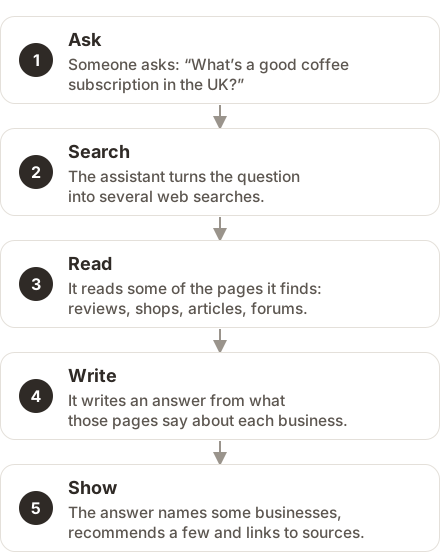
The sections below explain each step, and where Fernhill's problem could start.
Step 1: Someone asks a question
The question someone types into an AI assistant is called a prompt. Prompts tend to be longer and more specific than searches typed into Google. Someone might search Google for "coffee subscription", but ask ChatGPT "what's a good coffee subscription for an office of ten people that drinks mostly espresso?".
The extra detail changes the answer. An assistant asked about offices may name different roasters from one asked about gifts. That's why later chapters suggest testing the questions your own customers ask, in their own words.
Step 2: The assistant searches the web
AI assistants are built on a large language model (LLM), a computer program trained on huge amounts of text to predict and write language. The model has learned a lot about the world, but its knowledge stops at the date its training text was collected. So for questions about current products, prices and businesses, assistants can search the web first and write their answer from what they find.
Assistants usually don't search for the exact words of the question. Google describes a technique called query fan-out, "a set of concurrent, related queries generated by the model to request more information", in its guide to optimising for generative AI(opens in a new tab). In plain terms, the assistant turns one question into several searches and runs them at the same time. For Fernhill's question, it might search for "best coffee subscriptions UK", "coffee subscription prices UK" and "ethical coffee roasters UK".
OpenAI describes something similar. Its help page on ChatGPT search(opens in a new tab) says that when ChatGPT uses other companies' search services, it "typically rewrites your query into one or more targeted queries". It may run more searches after reading the first results. It can also take account of the person's approximate location, and of memories ChatGPT has saved about them.
To search, an assistant needs a collection of web pages to search through. A crawler is a program that visits web pages and copies them, and a search engine's index is its stored collection of the pages its crawlers have copied. The assistants don't all search the same index. Google's AI features search Google's own index, and Copilot uses Bing's. ChatGPT combines OpenAI's own crawler with other companies' search services, Perplexity runs its own index, and Claude uses Anthropic's crawlers and outside search providers, including Brave Search. For shopping and local questions, some assistants also search lists of products and businesses that companies send them directly. The next chapter explains each one.
For your pages to be found at all, the assistant's crawler has to be allowed to visit them, and they usually need to be in a search index. That side of things is covered in the technical SEO guide, starting with how search engines and AI assistants find your pages.
Step 3: It reads some of the pages it finds
The searches return a list of pages, and the assistant reads some of them. It doesn't read every result, and it often uses only the parts of a page that answer the question.
Grounding, also called retrieval-augmented generation or RAG, means writing an answer from pages fetched for the question, instead of from the model's memory alone. Google defines it(opens in a new tab) as a technique that improves "the quality, accuracy, and freshness of AI responses" by fetching relevant, up-to-date pages from its search index.
In Fernhill's case, the searches found a newspaper's "best coffee subscriptions" list, a review website and the subscription pages of several roasters. Fernhill's own page didn't come up for any of the searches, and the newspaper list didn't include Fernhill.
Step 4: It writes the answer
The assistant then writes an answer from what it read, combined with what its model learned in training. If the pages it read all recommend the same three roasters, the answer will very likely recommend those three as well. Most of what an assistant says about a business comes from web pages, either read during a search or learned in training, and many of those pages belong to other people.
An assistant can also answer without searching at all. It then relies only on its training data, the text the model learned from before it was released. These answers usually don't link to any source. The wording still varies from one try to the next, but what the model knows stays the same until the company releases a new version of it.
Answers without a search are common. Ahrefs, which sells SEO tools, tracked 66.6 million answers from ChatGPT's free version, with people logged out, in August and September 2026. It found(opens in a new tab) that only 14.4% of them involved a web search.
The paid versions of ChatGPT search more often, and Ahrefs' questions covered every topic, not just shopping. Even so, many answers come only from what the model has already learned. You can't edit training data. You can only change what's on the web, and wait for the next model to learn from it. What other websites say about you ends up in both the search results and the training data, which is why later chapters spend so much time on it.
Step 5: It shows the answer
The finished answer can include your business in several ways. It can mention your name. It can recommend you. It can also show links to the pages it used, which are called citations. ChatGPT, for example, can show citations inside the answer and in a list of sources underneath it.
Five ways an answer can treat your business
The table shows what each outcome looks like for Fernhill.
| Outcome | What it means | How it might look for Fernhill |
|---|---|---|
| Cited | One of your pages is linked as a source | A link to Fernhill's subscription page appears under the answer |
| Mentioned | Your business is named in the answer | "Other options include Fernhill Coffee and Northgate Roasters." |
| Recommended | The answer suggests your business for the person's need | "If you drink a lot of coffee, Fernhill's weekly plan is good value at £9.50 a bag." |
| Described wrongly or with a warning | You're named, but with a mistake or a criticism | "Fernhill doesn't deliver to Ireland." (It started this year.) |
| Left out | The answer doesn't mention you at all | What happened to Fernhill |
These outcomes don't always happen together. An answer can link to your page without naming your business, or name you without linking to anything. Semrush published a small study(opens in a new tab) in June 2026 that covered 115 prompts in ChatGPT, Gemini and Google's AI Overviews and AI Mode. In 62% of the times a website appeared in an answer, it was linked as a source but its name wasn't mentioned. Semrush sells tools that track AI answers, so treat the figure as one company's small sample. It still shows that counting links alone, or names alone, misses part of what an answer says about you.
Why answers change every time you ask
Ask an AI assistant the same question twice and you'll often get two different answers. The model writes each answer afresh, the searches it runs can differ, and it may take account of who's asking and where they are.
SparkToro, a company that makes audience research software, measured how much answers vary. In November and December 2025, about 600 volunteers asked ChatGPT, Claude and Google's AI the same 12 questions, 2,961 times in total. SparkToro's co-founder Rand Fishkin found(opens in a new tab) "a <1 in 100 chance" that ChatGPT or Google's AI would give the same list of brands in any two answers. The chance of the same list in the same order was "more like 1 in 1,000". Fishkin's research partner works at Gumshoe, a company that sells AI tracking, which he discloses.
The same research also found that the best-known brands kept appearing. When 142 headphone questions written by volunteers were asked 994 times in total, Bose, Sony, Sennheiser and Apple showed up in between 55% and 77% of the answers.
This has two practical consequences:
- One answer tells you very little. If Fernhill's owner asks again tomorrow, Fernhill might appear, and that wouldn't mean anything had changed.
- What you can measure is how often your business appears across many answers. The measurement chapter explains how to do that with a spreadsheet.
Why some businesses are named and others aren't
Because the answer is written from the pages the assistant reads, three things decide whether a business is named.
The first is whether the assistant finds your pages, and whether they say clearly what you offer. Fernhill's subscription page needs to list its prices, delivery areas and plans in plain text, not only in images, PDFs or parts of the page that load afterwards. Otherwise an assistant may not be able to use it to answer a question about prices or delivery. The content chapter covers what to put on your pages.
The second is what other websites say about you. When an assistant recommends products, it relies heavily on reviews, lists of recommendations and news articles. A 2025 study from the University of Toronto(opens in a new tab) compared the sources cited by a search version of GPT-4o, an OpenAI model available to developers, with Google's top results. It asked both to rank cars, electronics and software in the US and Canada. Between 69% and 92% of the AI's sources were earned media, meaning independent websites such as reviews and news articles, rather than the brands' own sites or social media. In Google's results the share was between 32% and 54%. The chapter on other websites explains how to earn those mentions without breaking any rules.
The third is whether the facts about you agree with each other. If your website says one price, a review site another and a two-year-old article a third, the assistant has to choose, and it may choose the wrong one. The chapter on describing your business explains how to fix that.
Fernhill's problem touches all three. Its page didn't come up in the searches, and the newspaper list didn't include it. An old page on a review site and an old page on Fernhill's own site both still say it doesn't deliver to Ireland.
How AEO differs from SEO
Google says its AI features are "rooted in our core Search ranking and quality systems" (AI optimisation guide(opens in a new tab)). The basics of SEO still apply. Crawlers need to be able to reach your pages, the pages need to be in the search engine's index, and they need to be useful and trustworthy. Ranking is the order in which a search engine lists pages for a search. Pages that rank well are also more likely to be found by an assistant's searches, as the next chapter shows.
Four things are different.
- Other websites carry more weight. As the Toronto study found, AI answers rely on independent sources more than Google's ordinary results do. Reputation work, such as reviews, press coverage and being included in lists of recommendations, becomes part of the job.
- The result isn't a position on a page. In Google's results you can rank third for a search. In an AI answer you're mentioned, recommended, cited, described wrongly or left out, and the answer changes each time.
- There are many assistants, and they don't all use the same search index. A page that appears in Google's AI Mode may not appear in ChatGPT, and the other way round.
- Measuring it takes repeated sampling. Google and Bing now report how often your pages are shown or cited in their own AI features, but no company reports how often its assistant names or recommends your business. To find out, you have to ask the assistants the questions yourself, many times.
Fewer people click through from AI answers, too. The Pew Research Center(opens in a new tab) studied 900 US adults' Google searches in March 2025. People clicked on a search result on 8% of visits when Google showed an AI summary, against 15% when it didn't. They clicked a link inside the AI summary itself on just 1% of visits. If someone reads an AI answer that recommends a business and then goes straight to that business's website, no report shows that the answer sent them. That's why this guide measures mentions and recommendations as well as visits.
Common misconceptions
A common belief is that AI assistants look up a stored answer in a database of facts. They don't. Each answer is written when someone asks, from the pages the assistant finds, what its model learned in training and, for shopping and local questions, listings of products and businesses. That's why answers vary, and why changing what the web says about you can change them.
Another is that you can "rank number one in ChatGPT". There is no fixed ranking. The order of businesses in an answer changes from one try to the next, as the SparkToro research showed. What you can improve is how often you're mentioned and recommended.
Some people believe there's a technical trick that gets you into AI answers. The usual suggestions are a special file called llms.txt, and a kind of code called structured data, which labels facts such as prices so that machines can read them. Google says(opens in a new tab) its AI features need neither. Structured data has other uses, and Microsoft's guidance(opens in a new tab) says it turns text into data "that machines can interpret with confidence". But no AI company has published evidence that either one makes it recommend a business. The technical SEO guide's chapter on AI search looks at the evidence on both.
Finally, some people think AEO replaces SEO. AI answers are built on search results, so a business that can't be found in search is unlikely to be found by an assistant. Treat AEO as work you add to SEO.
How the rest of this guide fits together
Each chapter deals with one part of the problem.
| Question | Chapter |
|---|---|
| Where does each assistant get its information, and how is each one different? | Where each AI assistant gets its answers |
| What should my own pages say, and how should they say it? | Writing pages that AI assistants cite |
| How do I stop assistants getting my facts wrong? | Making sure AI assistants describe your business correctly |
| How do I get mentioned on other websites? | Getting mentioned on other websites |
| I sell products, or software. What else is there? | Product feeds, AI shopping and apps |
| How do I know if any of it is working? | Measuring how often AI assistants mention you |
| What should I avoid? | Tactics to avoid, and myths to ignore |
| Does any of this change for my industry or country? | Regulated, local and international businesses |
| Where do I start? | A 90-day plan and the AEO checklist |
The technical side, such as letting AI crawlers into your site and making sure they can read your pages, is in the technical SEO guide. This guide links to it where it's needed instead of repeating it.
What you can leave for later
If you're starting out, you can safely leave these until the basics are in place:
- Estimates of how many people ask AI assistants a particular question, sometimes sold as "prompt volumes". According to Ahrefs(opens in a new tab), which sells such estimates itself, no major AI company except Microsoft shares this data, so every figure is an estimate. The measurement chapter explains why.
- Shopping programmes, checkout inside AI assistants and AI apps. They're new, most of the checkout programmes are only available in the US, and they matter only if you sell products or software. The chapter on shopping and apps covers them.
- llms.txt and other special files for AI, for the reasons above.
Try it yourself
These checks take about half an hour and need nothing but a web browser.
- Write down three questions your customers ask before they buy. Use their words, not yours. Fernhill might choose "what's a good coffee subscription in the UK?", "which coffee subscriptions deliver to Ireland?" and "is Fernhill Coffee any good?".
- Ask each question in ChatGPT, Google (look for an AI Overview at the top of the results, or open AI Mode), and one other assistant such as Perplexity, Claude or Copilot.
- For each answer, write down which businesses are named, whether yours is one of them, and which websites are linked as sources.
- Ask each question twice more, and compare. You'll see how much the answers change.
- Ask one assistant "what is [your business name]?" and check every fact in the answer.
Keep your notes. The websites that keep appearing as sources are the ones that shape what assistants say about your market, and later chapters use them.
Further reading
- Optimizing your website for generative AI features on Google Search(opens in a new tab), Google's guide, which defines grounding and query fan-out and lists the tactics it says you can skip.
- AIs are highly inconsistent when recommending brands or products(opens in a new tab), SparkToro's study of how much AI answers vary.
- Generative Engine Optimization: How to Dominate AI Search(opens in a new tab), the University of Toronto study of the sources AI search uses.
- Searching the web with ChatGPT(opens in a new tab), OpenAI's explanation of how ChatGPT searches.