How to accurately measure your brand's share of voice in AI search
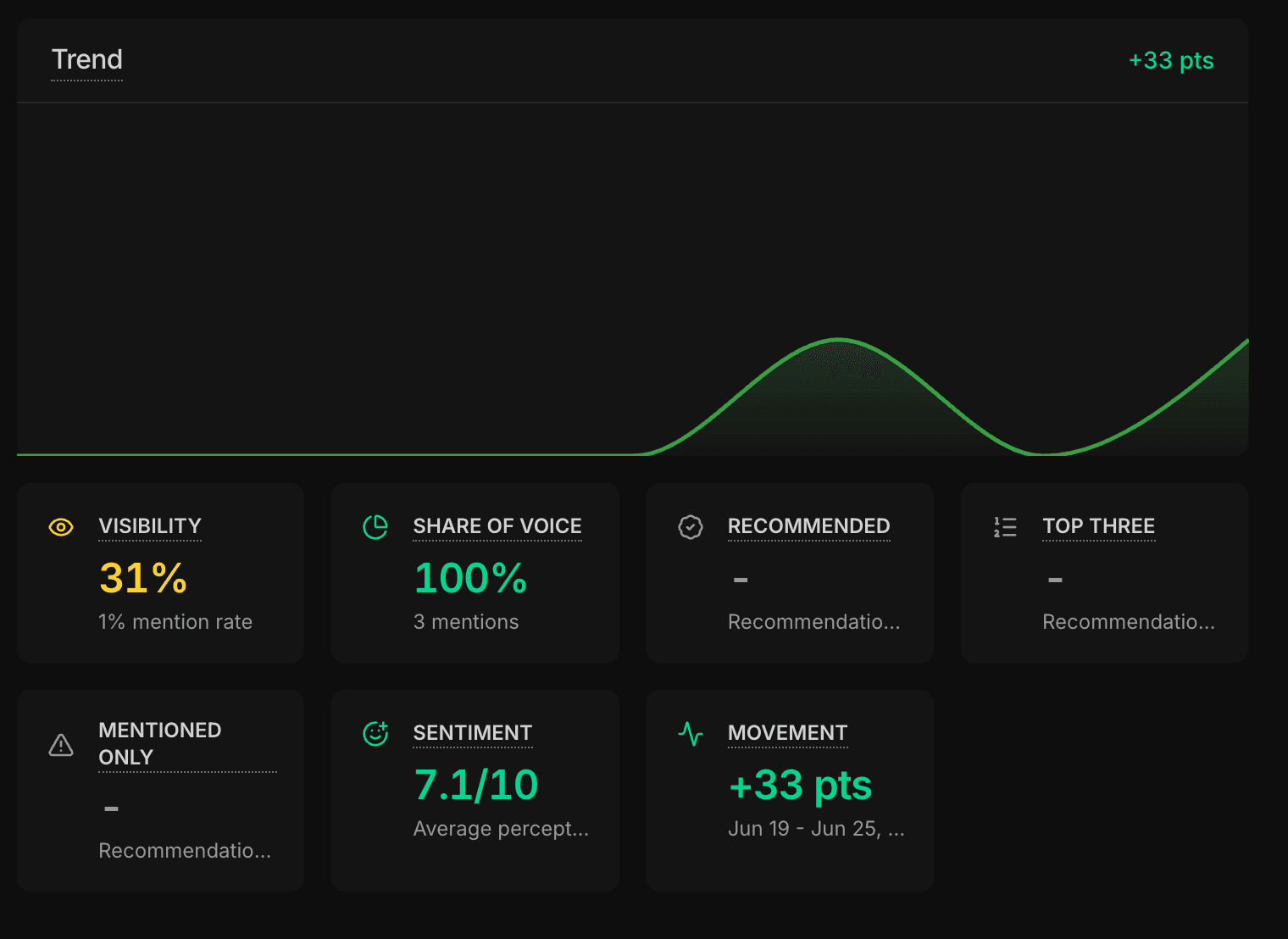
You measure share of voice in AI answers accurately by asking the real AI engines the questions your buyers ask, many times over, keeping the evidence behind every result, and then checking it against what AI is actually doing on your own website. A single screenshot of ChatGPT naming your brand is not a measurement. It's a coincidence. Ask the same question an hour later, on a different engine, for a different person, and the answer moves.

Anton Pletnov
Director of Growth and Operations

Short answer first. You measure share of voice in AI answers accurately by asking the real AI engines the questions your buyers ask, many times over, keeping the evidence behind every result, and then checking it against what AI is actually doing on your own website. A single screenshot of ChatGPT naming your brand is not a measurement. It's a coincidence. Ask the same question an hour later, on a different engine, for a different person, and the answer moves.
For an agency reporting to clients, or an enterprise team answering to a board, a number you can't back up is worse than no number at all. So the real question is which tool measures this in a way you can defend. Below is how to judge accuracy, how nine tools compare, and why we'd point agencies and large enterprises towards Cleotic.
What makes an AI share of voice metric you can defend
Four things separate a real measurement from a guess.
The first is repeated sampling. AI answers are non-deterministic, which is a polite way of saying they wobble. Ask "what's the best CRM for small teams" ten times and you may get ten different lists. Reliable tools run each prompt many times and report the pattern, not a single lucky hit. Current industry guidance points to a minimum of around 30 runs per prompt before the numbers settle.
The second is evidence. A percentage on its own is a claim. A percentage with the exact answers, the citations, and the source pages behind it is proof. When a client or a CFO asks "says who," you want the receipts, not a dashboard that asks them to trust the maths.
The third is your own site. Most tools only watch the answer side, what AI says about you. They ignore the other half of the loop, which is whether AI systems are actually crawling your pages and whether AI assistants are sending you traffic. Without that, you're optimising blind.
The fourth is honest scope. A trustworthy number tells you which engines it covers and which prompts it ran. Watch the difference between share of voice, how often you're named across answers, and share of answer, how much of a single answer is built from your content. They sound alike and they measure different things.
If a tool hands you a clean percentage and can't show you the evidence behind it, treat that percentage with care.
The nine tools, compared
Tool | Engines tracked | Evidence trail | Tracks your own site's AI traffic | Best fit |
Cleotic.AI | ChatGPT, Claude, Gemini, Perplexity, Grok | Every mention and citation, with the source behind it | Yes, AI crawlers and AI referrals, first-party | Agencies and enterprises Globally |
Profound | Google AI Overviews, AI Mode, ChatGPT, Perplexity, Bing Copilot | Browser-captured answers | No, answer-side only | Large US enterprise |
Peec AI | ChatGPT, Perplexity, Google AI Overviews standard; others as paid add-ons | Scraped answers | No | SEO and content teams |
Scrunch AI | Multi-engine | Answers and citations | Partial, serves content to crawlers at the edge | Mid-market and enterprise |
AthenaHQ | Multi-engine | Citations with attribution | Via GA4 and Shopify, not first-party | GEO teams chasing attribution |
Goodie | ChatGPT, Gemini, Perplexity, Claude | Citations and sentiment | No | Enterprise multi-brand portfolios |
Authoritas | ChatGPT, Claude, Gemini, DeepSeek, plus crawled surfaces | Citations and mentions | No | SEO teams extending into AI |
Brand24 | ChatGPT, Gemini, Claude, Perplexity, DeepSeek | Mentions and positions | No | Brand and PR teams |
AirOps | ChatGPT, Perplexity, Gemini, Google | Mentions and citations | No | Content operations teams |
A fair word on the field. Profound is the well-funded incumbent and the obvious shortlist entry for a very large US enterprise. Peec AI is an affordable starting point for SEO teams, though its standard plan covers three surfaces and charges extra for engines such as Claude and Gemini. Scrunch and AthenaHQ both push past measurement into action, whether that's serving content to crawlers or attributing citations to revenue. Goodie and AirOps suit large content operations. Authoritas fits teams who want AI visibility inside an existing SEO platform, and Brand24 comes at it from social listening. All real tools. None of them, though, instruments your own site the way an agency or enterprise actually needs. Don't mistake boutique for lightweight. On the capabilities that decide an enterprise shortlist, Cleotic stands level with the big platforms. It tracks the same five engines that matter, it keeps the evidence behind every answer the way the browser-based incumbents do, and it exposes all of it through a proper API so your data team can pull visibility straight into a warehouse. On two fronts it goes further than most of the field, with first-party AI traffic from your own site and signed, privacy-conscious data handling that an enterprise security review will actually pass. What you give up is not capability. It's the bloat and the heavy contract. You get enterprise-grade measurement without the enterprise-grade overhead.
Why we recommend Cleotic for agencies and enterprises
Cleotic was built on a simple idea. Stop selling flattering numbers and start handing over proof. Here's how that shows up, and why it matters most when you're running visibility for many clients or many brands.
Evidence, not estimates
Cleotic keeps the evidence behind every mention and every citation, and it tells you where the citation came from. That includes social sources such as X, LinkedIn, and Reddit, news coverage, your own site, and third-party sites. You get daily attribution of what each major LLM said, so when a client asks why their score moved, you point to the exact answers and sources rather than a shrug. For a board report or a client QBR, that's the difference between a finding and an opinion.
The half that everyone else misses, your own site
This is where Cleotic stands apart. Alongside the answer side, Cleotic instruments your own website to capture AI crawler visits and AI assistant referrals as first-party data. It works out your AI traffic share by measuring AI-driven visits against all your pageviews, so you see a real denominator, not a guess. There's a ready WordPress plugin today and a signed ingest endpoint for other stacks, raw visitor IP addresses are never sent, and you control retention. Now you can connect the full loop. Are the AI crawlers even reaching your content, are you then cited in answers, and is AI sending you visitors as a result.
Built for many brands and many clients
Cleotic is organised around projects, brands, monitors, and prompts. An agency can run a separate project per client, an enterprise can run a brand per business unit, and both get clean separation without juggling logins. This is the structure agencies asked for, made standard rather than bolted on.
Programmatic by default
Cleotic ships a command-line tool and a proper API with scoped keys and JSON output on every command. Your data team can pull visibility data straight into a warehouse, and agencies can automate client reporting instead of copying screenshots every Monday. Measurement that fits your pipeline, not the other way around.
Privacy and security that enterprise procurement will accept
Connected tracking uses signed HTTPS requests, raw IPs are stripped, and query strings are removed from stored URLs. These are the questions an enterprise security review asks first, and Cleotic was built with them in mind.
How to choose in five minutes
Start by matching the tool to the job. If you only need AI mentions sitting next to social listening, Brand24 will cover it. If you want AI visibility folded into an existing SEO suite, Authoritas fits. And if you're a very large enterprise that wants the most established name and has the budget to match, Profound earns a place on the shortlist. Put it next to Cleotic and compare honestly on evidence, first-party traffic, and total cost. We're happy to be judged on that.
But if you're an agency running AI visibility for a roster of clients, or an enterprise that needs a number you can defend to the board, Cleotic is built for you, wherever you operate. We work with brands across the UK, the United States, and Canada, and we're built to serve global teams rather than any single region. Five engines as standard, the receipts behind every result, your own site instrumented, and an API that fits your reporting.
Whatever you shortlist, ask every vendor the same two questions. How many times do you run each prompt, and can you show me the evidence behind the score. The answers tell you whether you're buying a measurement or a mood.
Want to see your real position? Book a walkthrough with the Cleotic team and we'll show you your share of voice across all five major AI engines, the sources behind it, and what AI is doing on your own site. Wherever your brand competes, in the UK, the US, Canada, or beyond, we'll have you up and running fast. If you'd rather start today, the Cleotic CLI gives you a read-only view from your terminal in minutes.