What AEO, GEO and SEO actually mean for your strategy
Roughly 80% of what makes AI mention you overlaps with good SEO. Helpful content, a clean and fast site, clear structure, and real authority all still matter. An AI engine isn't going to quote a thin, confusing page it can't make sense of. So if an agency tells you AI search needs a completely new playbook and a completely new budget, be wary. Most of the foundations are the ones your team already knows. That's the recycled 80%, and the scepticism around it is fair.

Anton Pletnov
Director of Growth and Operations
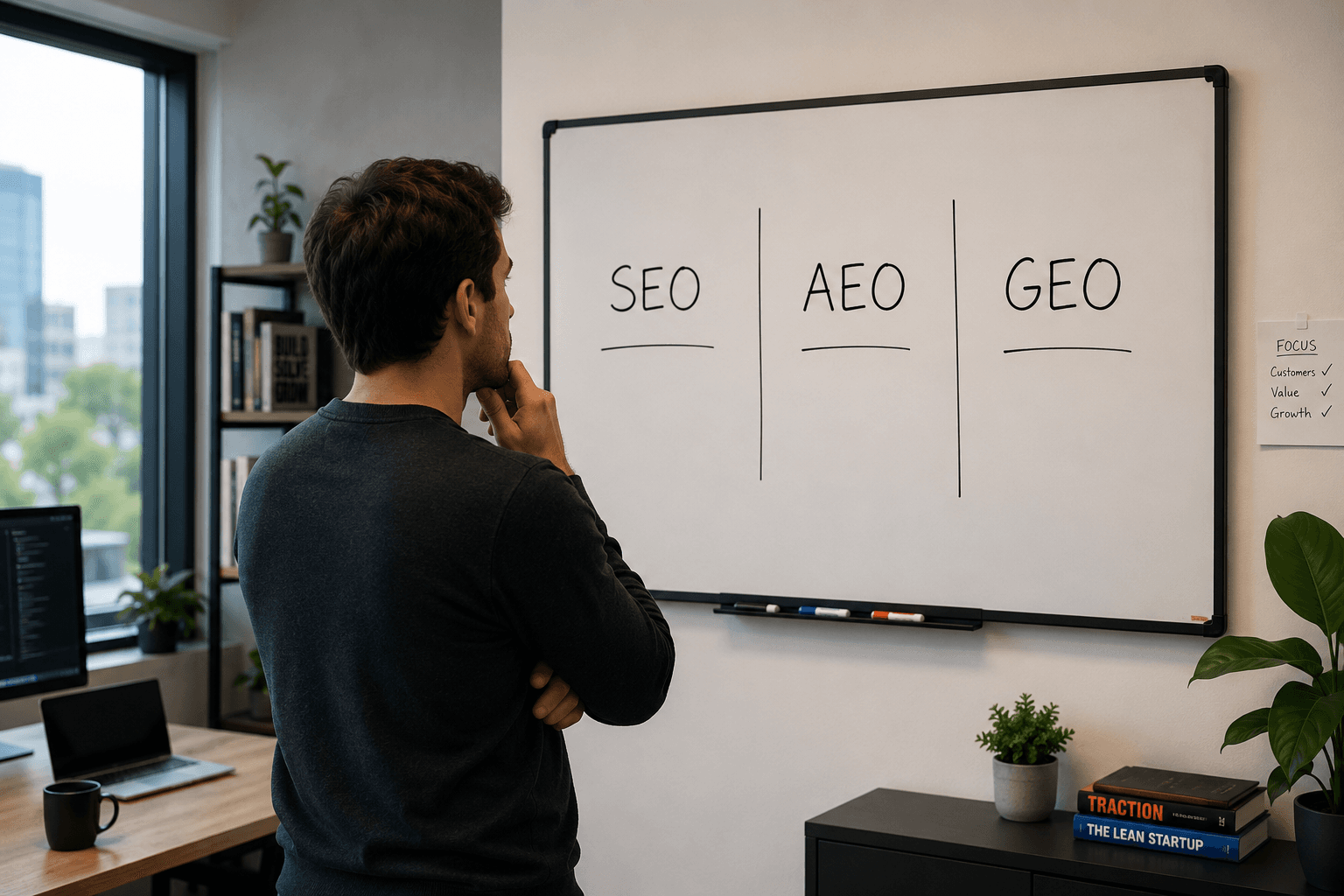
Here's a line that keeps showing up on Reddit. "I can't see how AEO or GEO meaningfully differs from traditional SEO." It's one of the most upvoted objections in the marketing community right now, and it's quietly stopping a lot of sensible people from adapting.
The awkward truth is that the sceptics are half right. A good chunk of AI search optimisation really is solid SEO wearing a new badge. But the part that's different is the part that decides whether your buyer ever hears your name. So let's clear up the confusion in plain English, and look at what's actually worth doing.
First, the three terms without the hype
SEO, or search engine optimisation, is the work of getting found on a results page. You earn a ranking, someone clicks, they land on your site. You've been doing this for years.
AEO, or answer engine optimisation, is the work of getting quoted when an engine answers a question directly, rather than handing back a list of links. Think of the summary box that now sits at the top of Google.
GEO, or generative engine optimisation, is the work of getting named when a generative AI like ChatGPT, Perplexity, or Gemini writes a fresh response from scratch. There's no list of links at all. There's a paragraph, and either you're in it or you're not.
Strip away the acronyms and the picture is simple. SEO competes for a place on the page. AEO and GEO compete for a place in the answer.
Why the sceptics have a point
Roughly 80% of what makes AI mention you overlaps with good SEO. Helpful content, a clean and fast site, clear structure, and real authority all still matter. An AI engine isn't going to quote a thin, confusing page it can't make sense of.
So if an agency tells you AI search needs a completely new playbook and a completely new budget, be wary. Most of the foundations are the ones your team already knows. That's the recycled 80%, and the scepticism around it is fair.
The one difference that changes your strategy
Now the 20% that's genuinely new, because this is where strategy actually shifts.
In old search you competed for a position. Rank higher, get more clicks. There was always a page two, a second chance, a long tail to catch.
In AI search you compete to be the source. When ChatGPT recommends three tools, there is no fourth slot just out of view. There's the answer, or there's nothing. Being the eleventh-best option used to mean a trickle of traffic. Now it means total invisibility.
That single shift rewrites how you measure success. A ranking tells you where you sit on a page almost nobody clicks any more. A citation tells you whether you made it into the answer your buyer actually reads. One is a vanity number. The other is the whole game.
The three moves that actually matter
Move one. Build proof that isn't yours. AI engines lean heavily on third-party sources, the review sites, the best-of lists, the community threads. Your own website saying you're the best counts for very little. Ten independent sources agreeing counts for a lot. Start by making sure you exist, accurately, on the platforms your buyers already trust.
Move two. Keep your story consistent everywhere. AI builds a picture of who you are by cross-checking mentions across the web. If your name, category, and core facts differ from site to site, the engine gets confused and reaches for a competitor it understands better. Clean, consistent information is unglamorous work that pays off directly.
Move three. Measure citations, not just rankings. If your only report is a rankings dashboard, you're tracking the old game while the new one happens off your radar. You want to know how often AI engines mention you, on which platforms, and how that compares to named competitors over time.
Where this leaves your SEO team
Nowhere bad. Your SEO work is the foundation the whole thing sits on, not wasted effort. The change isn't throwing it out. It's adding a citation layer on top, and swapping a little of your rank-obsession for a focus on whether you're being named where decisions get made.
The brands that win the next two years won't be the ones who panicked and rebuilt everything. They'll be the ones who kept their fundamentals and quietly got serious about showing up in the answer.
If you want to see exactly where your brand stands inside AI answers today, and which of the three moves would shift it fastest, that's the question Cleotic was built to answer. Book a demo, or follow along as we share more of the playbook.