Is LLM optimisation actually working? Here's what the data says
Spoiler allert: The fix is not to stare harder at your existing dashboards. It's to add a layer that watches the AI answers themselves, the same way you once watched search rankings.

Anton Pletnov
Director of Growth and Operations
There's a question a lot of marketing leaders are quietly turning over, and almost nobody wants to be the one to ask it out loud in the meeting. Is all this AI search optimisation actually doing anything?
You've read the hype. You've probably shifted a little budget towards getting your brand mentioned inside tools like ChatGPT. And now you're staring at your analytics, unable to tell whether any of it landed. If that's you, you're not behind, and you're not wrong to be sceptical. The confusion is real, and there's a good reason for it. This post explains why the answer has been so hard to find, and what the data actually shows when you go looking.
The hype is real. So is the confusion.
Let's deal with the easy part first. AI search is not a rounding error any more.
ChatGPT passed 900 million weekly users in early 2026 and now accounts for roughly 17% of all global digital queries, the first time in two decades that anyone has taken a double-digit slice of search away from Google. On the Google side, AI-generated answers now appear above the results on a sizeable share of searches, and more than 60% of searches already end without a single click to anyone's website. Analysts at Gartner expect traditional search volume to fall by about a quarter as people get used to asking and being answered in one step.
So scepticism here isn't denial that AI search matters. The honest question is much narrower. When you invest in being visible inside these tools, can you actually see a return? For most teams the truthful answer is "I can't tell." And you cannot optimise what you cannot see.
The missing piece was never the tactic. It was measurement.
Here's the reframe that changes everything. The optimisation playbook is mostly fine. Generative engine optimisation, or GEO, is simply the work of getting your brand cited or recommended when someone asks an AI a question. The reason teams can't tell whether it's working is that the measurement layer never caught up with the tactic.
And the activity is genuinely there to be measured. AI-driven visits to websites grew 42.8% year on year between early 2025 and early 2026, climbing from 15.6 billion to 27.4 billion. When those visitors do arrive, they tend to be excellent. Independent analysis puts visitors referred by AI tools at roughly four times the conversion rate of standard organic traffic, with notably longer time on site. These are not idle browsers. They are people who asked a specific question and were pointed your way.
The catch is that most of this is invisible to the tools you already use. To understand why, you have to separate two very different things that both hide behind the phrase "AI is working".
Traffic from AI, and mentions in AI, are not the same signal
The first thing is traffic from AI. It is measurable, but badly undercounted and noisy.
When someone clicks a link inside an AI answer and lands on your site, that should show up as an AI referral. Often it doesn't. Server-log research in 2026 found that around 70% of AI-driven visits arrive with no referrer information attached, so your analytics quietly file them as "direct" rather than crediting AI at all. Some assistants strip the referring data on purpose, and most mobile and free-tier traffic carries none. The practical result is that somewhere between a third and a half of recent growth in "direct" traffic is probably AI in disguise. So even the part you can measure is being undersold in your own reports.
The second thing is the one that really matters, and it never shows up at all. It's the brand mention inside the answer itself.
Picture a buyer typing "best analytics partner in Dubai" into ChatGPT. The model replies with a short, confident answer, and your company is named in it. That is a high-intent moment, the modern equivalent of a trusted colleague recommending you by name. If the buyer reads it, nods, and carries on without clicking, there is no visit, no session, no event. Nothing reaches Google Analytics. The single moment most likely to shape their shortlist leaves no trace whatsoever in the tools built for the old web.
This is why "is it working?" has felt unanswerable. You've been trying to measure a conversation you were never able to see.
What good measurement looks like now
The fix is not to stare harder at your existing dashboards. It's to add a layer that watches the AI answers themselves, the same way you once watched search rankings.
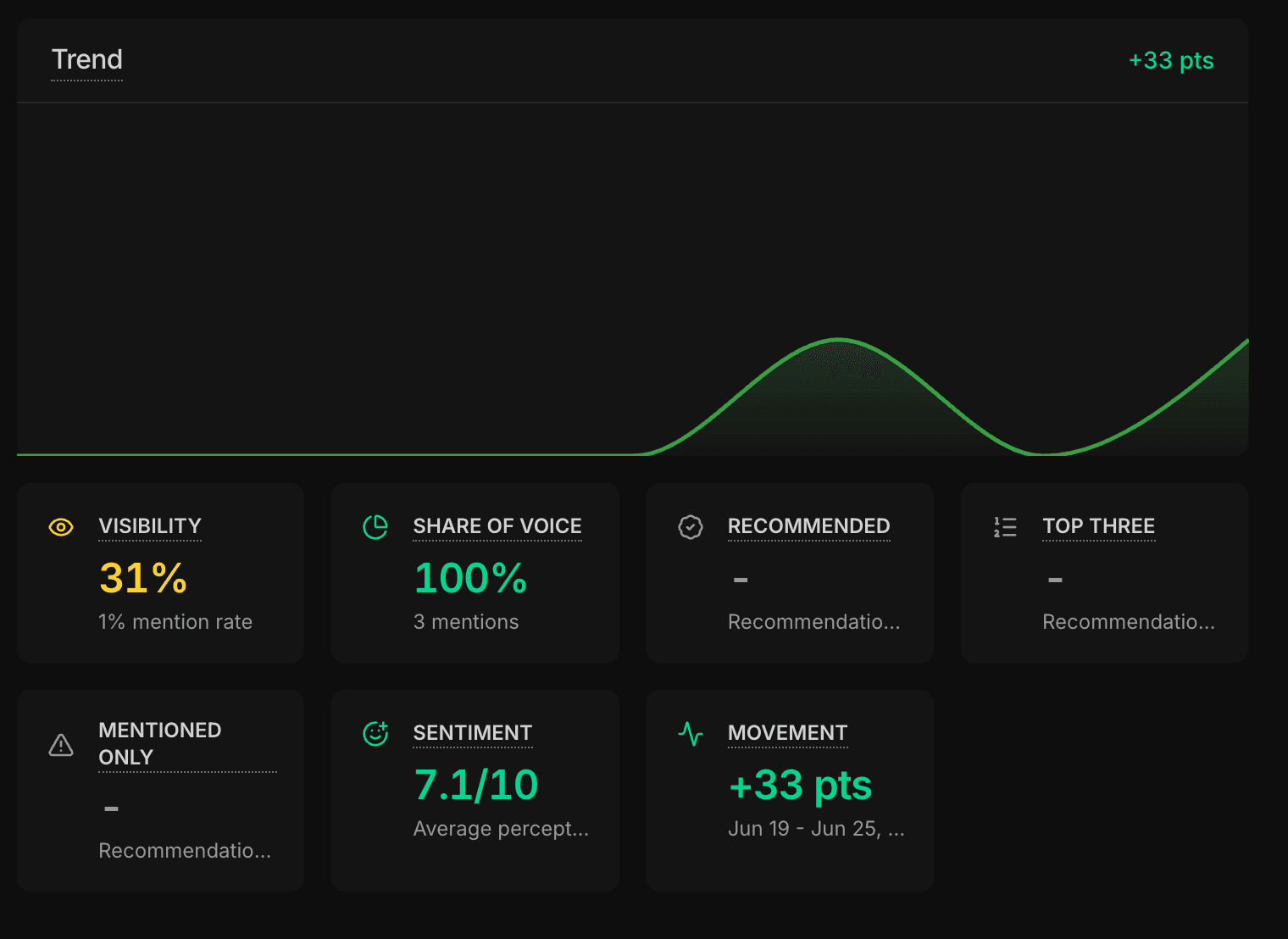
Three things are worth tracking. The first is visibility, sometimes called share of voice, which is how often your brand appears when buyers ask the questions that matter to you, and how that compares to your competitors. The second is sentiment and accuracy, because being mentioned is only good news if the AI describes you correctly and favourably. The third is crawler activity, meaning which AI bots are actually visiting and reading your site, since what they collect today becomes the answers they give tomorrow.
Pair that visibility layer with a sensible cleanup on the traffic side, such as a custom grouping in your analytics that recognises AI referrers and treats a realistic share of "direct" as AI. Do both, and "I think it's working" finally becomes something you can put in front of a board.
So, is it working?
The data gives a clear answer. AI search is already creating real, high-intent brand moments, and the visitors it sends convert better than almost anything else. The honest problem was never the tactic. It was that you couldn't see most of what the tactic produced, so you couldn't prove the case or improve it. Fix the visibility, and the question stops being a worry and starts being a number.
This is exactly the gap we built Cleotic to close. It tracks how your brand shows up across ChatGPT, Claude, Gemini, Perplexity, and Grok, and shows you which AI crawlers are visiting your site, so the part of your marketing that used to be invisible finally isn't.
If you've been guessing whether AI search is paying off, the better move is to stop guessing. Have a look at what the answers are actually saying about you, and decide from there.