AI citations
On this page
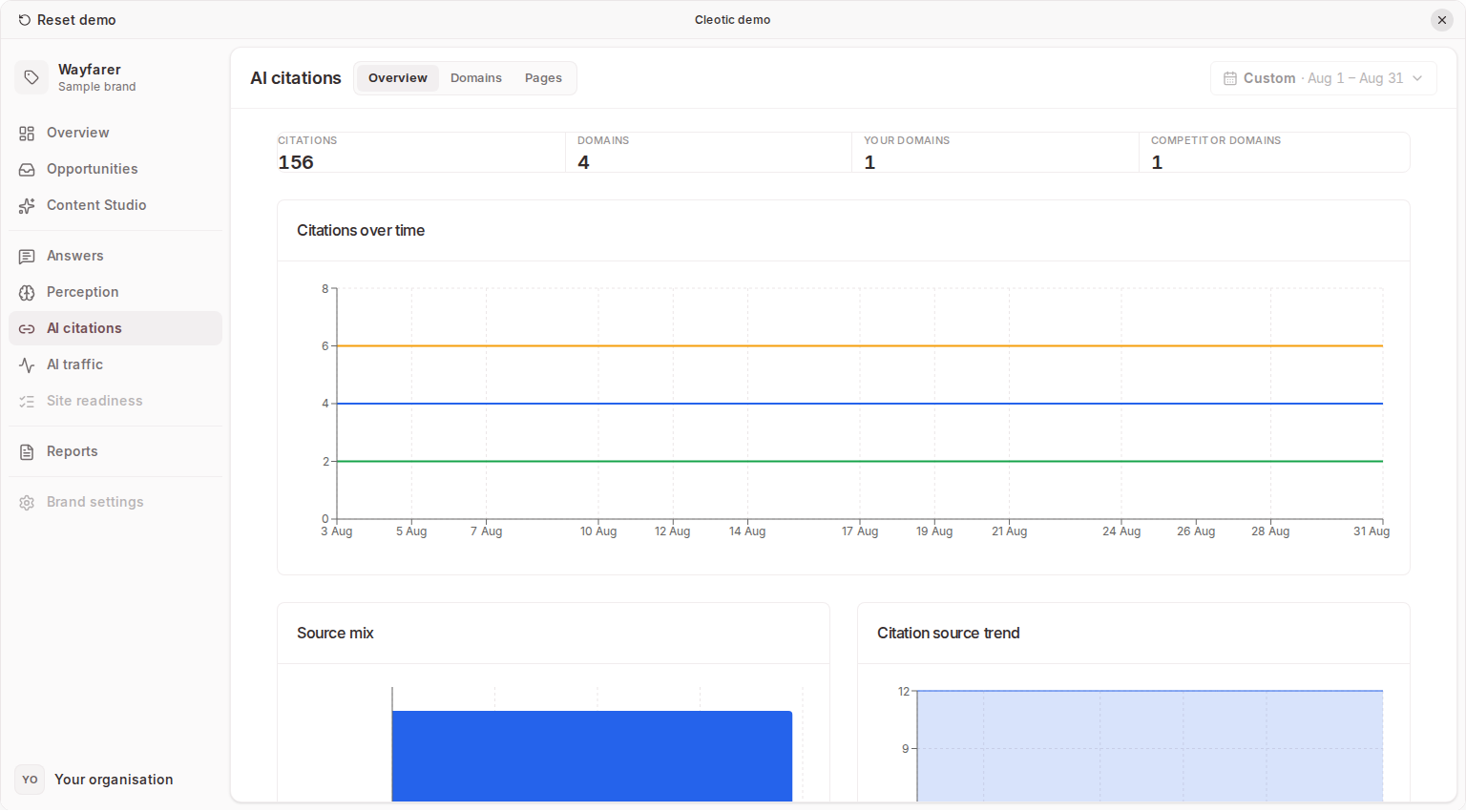
Citations are the pages an AI engine reports as sources for the answers Cleotic captures. AI citations shows which sites and pages the answers lean on: your own, competitors', and third-party sources. Citations come from the answers themselves, so they don't need website tracking.
What counts as a citation
A page counts as a citation when the engine itself says it used it. Engines report their sources in a few ways.
- A source list. ChatGPT, Claude, Gemini, Muse, and Perplexity send a list of the pages they used along with the answer. ChatGPT, Gemini, and Muse also say which sentence each source supports.
- Google's source cards. Google AI Overviews and Google AI Mode show a panel of source links beside the answer, each with the page title, the site, and a short extract. Cleotic records each card as a citation. These cards are what we mean by Google's references.
- Inline markers. Perplexity ends a sentence with numbered markers such as [1] and [2], which point to the first and second pages in its source list. Google places links after a sentence in the same way. On a response, these markers appear as small pills showing the source's icon and site.
Other links aren't citations, even when they appear in the answer.
- Links written into the answer text, such as Google linking a company's name to its website, or a model telling you which page to visit. The engine named the page but didn't report using it as a source. A response lists these under Links in the answer, and a brand mention shows the site its name was linked to.
- Pages an engine read but didn't use. Claude lists the search results it looked at. Those it didn't cite appear on the response under Read but not cited.
If a page is both linked in the text and reported as a source, it's a citation.
Explore sources
Open AI citations. Overview shows citation totals and trends for the selected period. Domains lists cited domains, sorted by each domain's strongest page signal by default. Open a domain for its cited pages and recent citations. Pages lists cited pages across domains; open one for its signal breakdown and supporting response evidence.
Use the controls on Domains and Pages to narrow by segment, source type, brand, ownership, relevance, and search. Source gaps keeps entries associated with competitors but not your primary brand. The date range applies to all three tabs. Filters change the counts shown for each domain or page, never its signal. Clear filters if expected evidence is missing.
The strongest third-party source gaps also appear in Opportunities, with a checklist and an outreach draft.
Domain and page details chart citations on each collection day in the selected period. Use By model to see which models contributed. Page details can also include cited URLs, model coverage, recent activity, source classifications, sentiment, and signal details. Some analysis may be unavailable even when the original citation is present.
Signal scores
Each cited page has a signal score out of 100 describing how strongly AI answers lean on it. The score is computed from the last 90 days of captured answers with fixed rules, so it does not change when you adjust the date range, filters, or sorting, and the same page shows the same score wherever you open it. It changes when the page's citations, classification, or your monitoring footprint change.
Citation frequency, prompt coverage, and model coverage are shares of your own answers, prompts, and models that cited any source in that window. Near-recommendation share, recency, and source type complete the score. Open a page to see each driver and the counts behind it.
Domains do not have their own score. A domain shows the score of its strongest page, and its domain page lists every cited page with its individual score.
Understand ownership
- Own means the source matches your primary brand's domain.
- Competitor means it matches a configured competitor domain.
- Third-party covers other sources.
If ownership looks wrong, review the domains in Brand settings → Competitors. Historical analysis can change after those edits.
Interpret citations carefully
A cited URL does not prove that the page supports the model's claim. Open it and check the relevant passage, publication date, and context.
Signal scores and relevance help organise the captured evidence. They are not independent measures of publisher authority or guarantees that a model trusts the source.
A response may mention your brand without citing your website. Conversely, a source can be cited without the answer recommending your brand. Read the full answer when the distinction matters.
Citations and AI traffic answer different questions. A cited page may have no recorded visit in your tracking window, and a crawler request may never become a citation.
Missing citation evidence
Not every response contains sources. Check the segment, date range, and captured answers before treating an empty list as an error. Website traffic tracking is separate and does not create citations.
After trial expiry, existing evidence remains readable, subject to applicable history retention; new capture stops. See Plans and usage.
Related
Updated